Esade’s SoReDI Chair, supported by Exea Impact, presents its first report on AI and youth loneliness
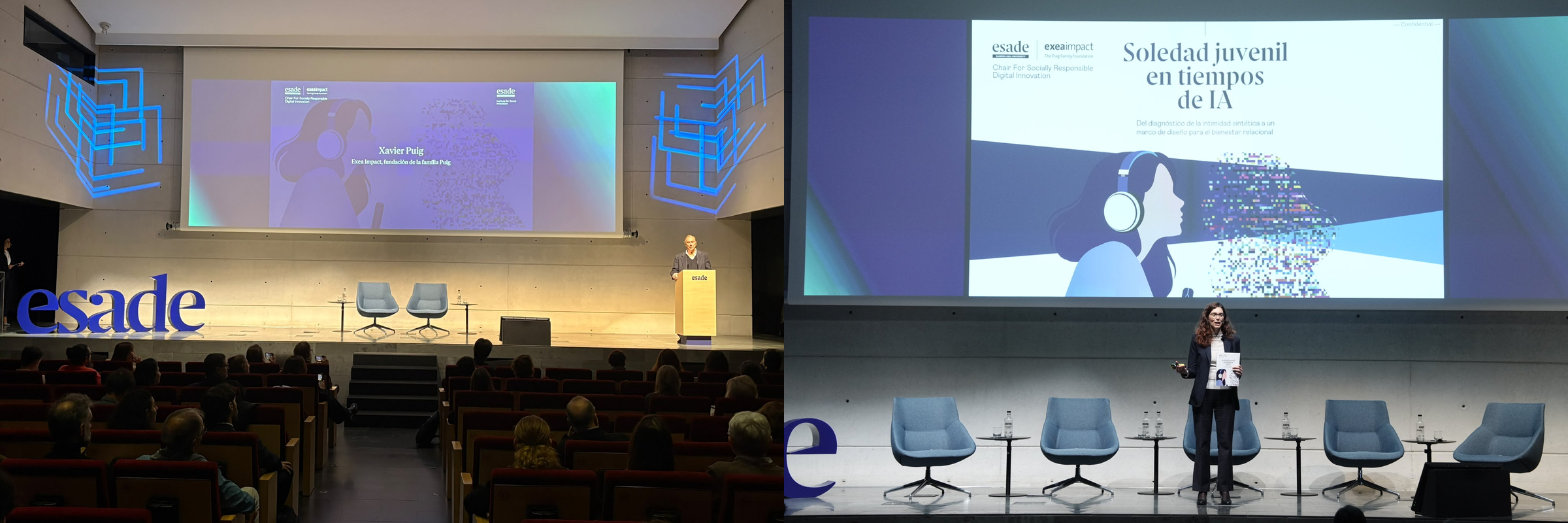
Youth loneliness predates the widespread adoption of generative artificial intelligence, but chatbots are changing how some young people seek companionship. This is one of the findings of Youth Loneliness in the Age of AI: From Understanding Synthetic Intimacy to a Design Framework for Relational Wellbeing, the first report by Esade’s SoReDI Chair, supported by Exea Impact. The study was presented on 26 November at Esade Forum.
Seeking companionship through chatbots
In Spain, 25.5% of young people aged 16 to 29 report feeling lonely, according to data from the State Observatory on Unwanted Loneliness cited in the report. The authors use the term ‘synthetic intimacy’ to describe the sense of closeness that can arise when talking to a chatbot. While this interaction may temporarily ease loneliness, it does not offer the reciprocity of a human relationship and may carry long-term risks.
The study identifies potential risks associated with intensive use, including emotional dependence and the displacement of personal relationships, although the available evidence does not establish a conclusive causal link. It also examines the ‘attachment economy’: business models that can encourage users to keep a conversation going, even when they might be better served by ending it and seeking support from people around them.
AI that supports human connection
The report proposes the SoReDI Framework to guide the design of these tools. Its criteria include making clear when someone is interacting with AI, allowing users to end a conversation without emotional pressure, avoiding responses that simply agree with them, and helping them connect with people or access support resources when appropriate.
The presentation, led by Liliana Arroyo, director of the SoReDI Chair and co-author of the report, brought together nearly 100 people. The event featured contributions from specialists including Giada Pistilli and Ariel Guersenzvaig, as well as young people who shared proposals for testing the framework and connecting AI use with resources and communities in their local area.
In his opening remarks, Xavier Puig, president of Exea Impact, highlighted that addressing youth loneliness is a priority for the foundation. Its support for the SoReDI Chair is part of the ‘Loneliness in Childhood and Adolescence in an Age of Hyperconnectivity’ initiative, through which Exea Impact helps build understanding of how technology is reshaping young people’s relationships and supports the development of responses that strengthen their connections and wellbeing.